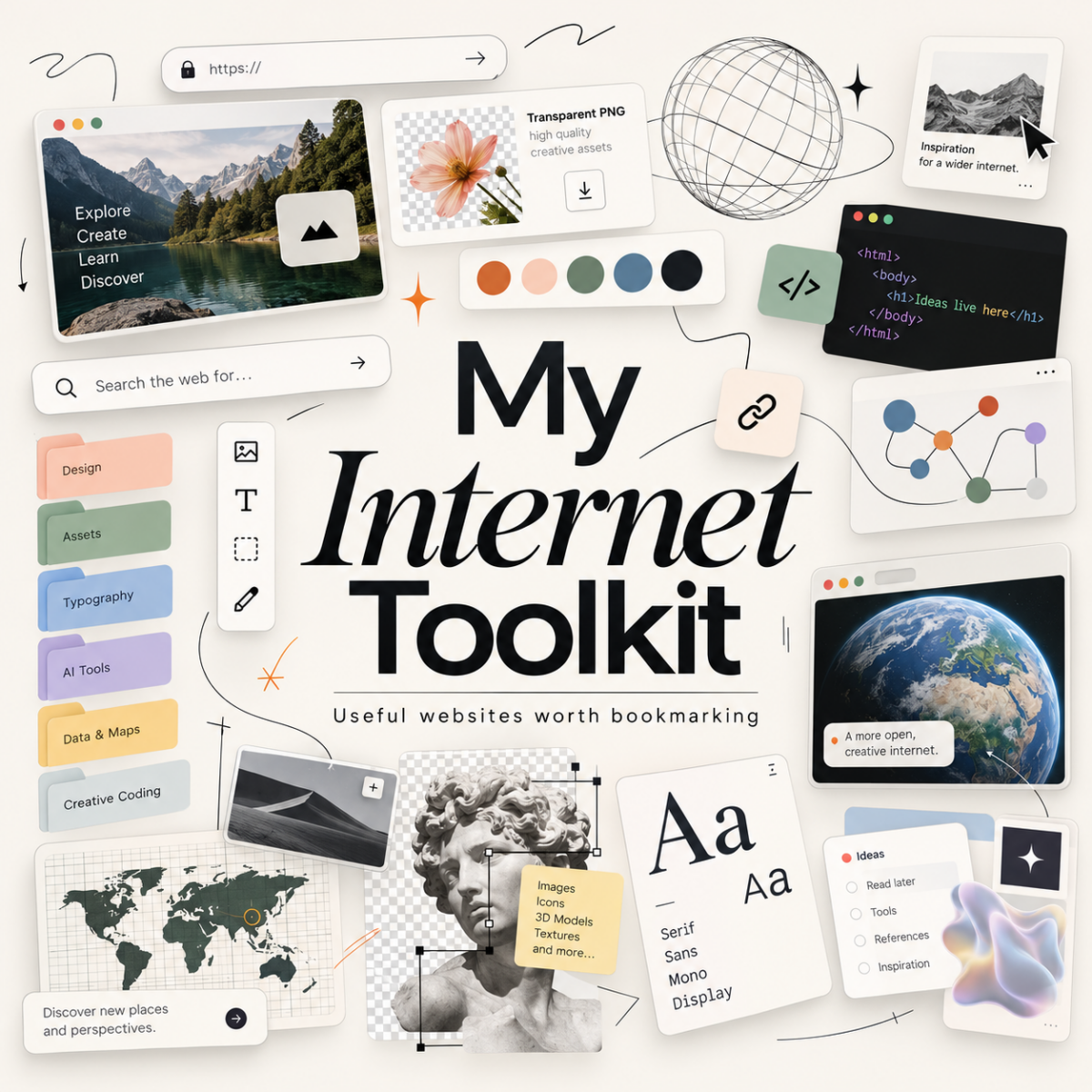
Creating never happens in isolation. Whether I’m working on digital art, experimenting with code or building something new, I constantly rely on resources I find online to learn, explore ideas and make things easier.
Over time, I’ve collected quite a few websites that I keep coming back to. Practical tools, sources of inspiration and a few random websites I enjoy to waste time on.
Here’s a collection of websites I love and think are worth bookmarking.
Images & Assets
- PNGimg — Thousands of transparent PNG images. A favourite for quickly finding objects to use in digital compositions without spending time removing backgrounds.
- Photopea — A Photoshop-like image editor in your browser. Surprisingly capable for something that requires no installation.
- SVG Backgrounds — Customizable vector backgrounds.
- Openverse — Search openly licensed images and media.
- Wikimedia Commons — An enormous archive of images, illustrations and historical material. One of my favourite places to find unexpected visual material, particularly historical illustrations and scientific imagery.
Design & Colour
- Realtime Colors — Preview colour combinations in actual interfaces.
- Fontshare — Free typefaces.
- Typewolf — Typography inspiration from real websites.
- Same Energy — Discover images through visual similarity. I like the idea of searching by visual feeling rather than keywords. It’s a more natural way to explore aesthetic references.
- Are.na — Collect and connect visual references, ideas and research. A good alternative to algorithm-driven inspiration feeds. More about making connections between ideas than endlessly scrolling.
Creative Coding & Generative Art
- Shadertoy — An endless collection of experimental GPU shaders. One of the most interesting places to explore what’s possible with mathematics and graphics programming. Some remarkably complex visuals emerge from very little code.
- OpenProcessing — Generative art and creative coding sketches. A great source of inspiration for my own generative art projects. I particularly enjoy seeing how simple rules produce unexpected compositions.
- The Book of Shaders — Learn the mathematics behind procedural graphics.
- Inigo Quilez — Excellent articles on rendering, geometry and shaders.
- Three.js Examples — Interactive 3D experiments and implementations. An invaluable reference for working with 3D in the browser, especially lighting, materials and procedural geometry.
- Codrops — Creative web development, animations and interactions.
Development & AI
- Transform.tools — Convert between code and data formats.
- JSON Crack — Visualize JSON as diagrams.
- Hoppscotch — Test APIs directly in your browser.
- Can I Use — Check browser compatibility.
- Hugging Face Spaces — Explore interactive AI experiments. A useful place to discover what people are building with AI beyond the usual chat interfaces. I find the smaller, specialized applications especially interesting.
- GitHub Trending — Find interesting open-source projects. A good way to discover tools, libraries and ideas I wouldn’t necessarily know to search for.
Data & Knowledge
- Public APIs — Discover public APIs for new projects. An excellent starting point when brainstorming applications. Sometimes the availability of an unusual dataset is enough to inspire an entire project.
- Wikidata — A vast interconnected knowledge base.
- Google Dataset Search — Find datasets from across the web.
- Internet Archive — Books, software, films and historical collections. One of the internet’s most valuable resources. I particularly enjoy browsing old publications, obsolete software and cultural material that would otherwise be difficult to find.
- Europeana — Europe’s digitized cultural heritage.
- CBS Open Data — Dutch statistics and datasets.
- GBIF — Global biodiversity data.
Internet Curiosities
- McStumble — Browser tools and unusual website discovery. Exactly the kind of website I enjoy: a collection of small utilities and discoveries that reminds me how diverse the web can be.
- Neal.fun — Playful interactive experiments. One of my favourite examples of what web development can be. Simple concepts, excellent execution and interactions that make you curious enough to keep exploring.
- The Useless Web — Random, strange and occasionally brilliant websites.
- Radio Garden — Explore live radio stations on an interactive globe. A beautiful example of combining a global dataset with one intuitive interaction. You immediately understand how to use it.
- WindowSwap — Look through someone else’s window, somewhere in the world.
- Nicky Case — Interactive explanations of complex ideas. I really admire this approach to communicating information. Instead of just explaining something, you let people interact with the underlying system and discover how it works.
What interests me most about these websites isn’t necessarily their functionality. It’s how much you can do with a simple idea, a browser and a bit of experimentation.
I’ll keep adding to this collection as I discover more.