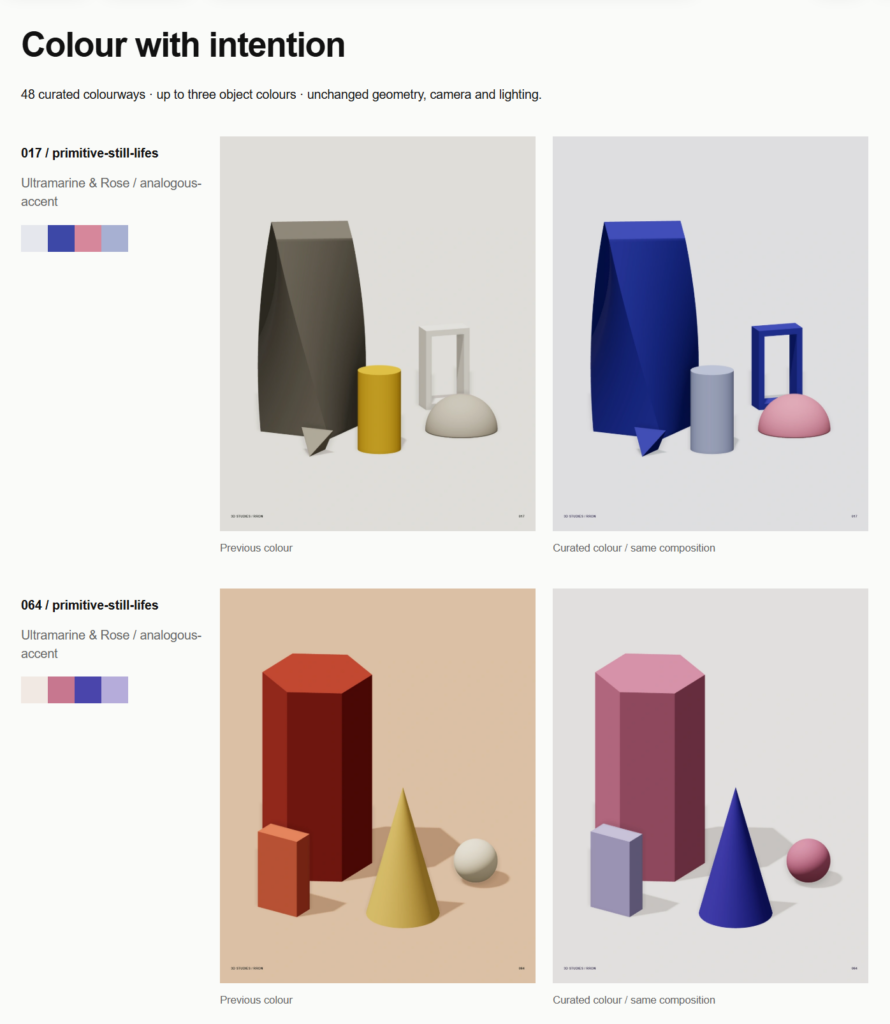
I’ve been experimenting with a different way of making art using AI. Instead of creating individual pieces, I’ve been trying to build systems that can generate hundreds of them.
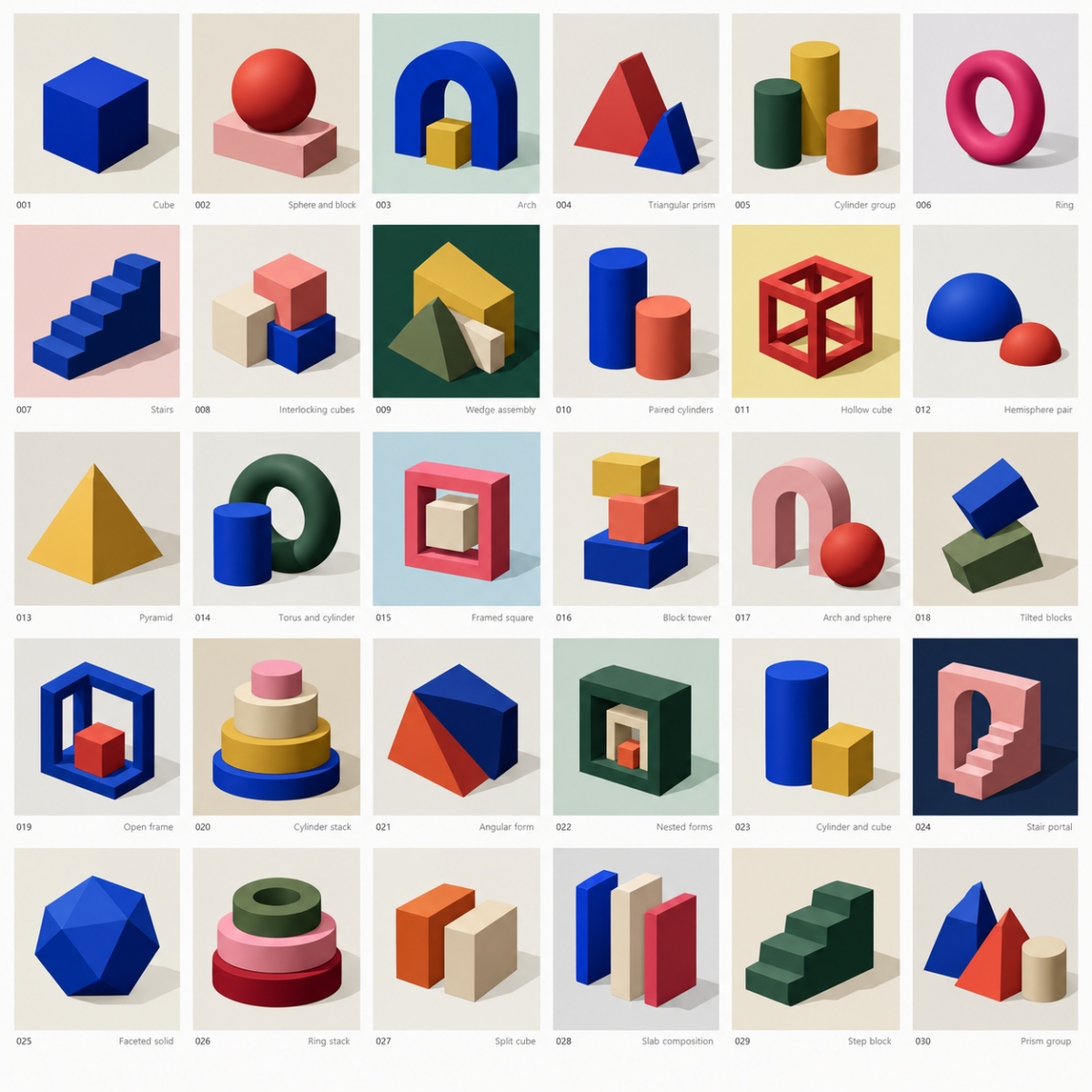
My project, 3D Studies, is a collection of 500 geometric 3D posters. And while I like the results I think the most interesting thing is how I made them.
Making the rules instead of the artwork
Normally, creating 500 different 3D compositions would mean spending a lot of time modelling objects, arranging scenes, setting up lighting and rendering everything.
Instead, I opened Codex and started describing what I wanted.
We began with a small collection of 3D shapes: cubes, spheres, pyramids, cylinders and a few variations. I showed it some of my older artwork and explained the style I was after. Simple geometric compositions, centered like little still lifes, with carefully chosen colours, clean lighting and plenty of empty space.
From there, we worked out how to build a generator using Three.js. I didn’t want 500 copies of the same poster, but a system that could combine shapes, colours and compositions in different ways while keeping a consistent style.
The interesting part was that I wasn’t really designing individual artworks anymore. I was designing the rules for how they should be made.
A lot of trial and error
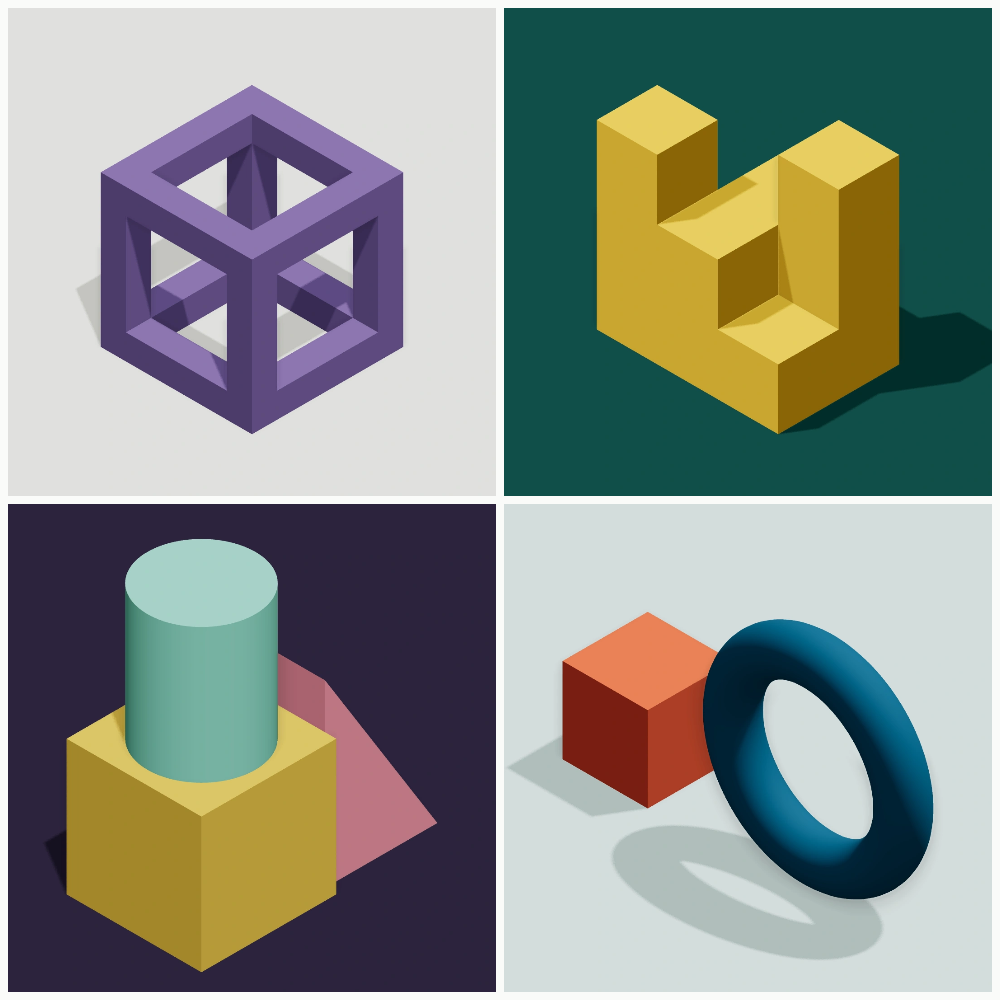
The first results weren’t particularly good.
Objects would float, intersect in strange ways or stick out where they shouldn’t. Shadows were wrong, proportions felt off and some compositions just looked bad.
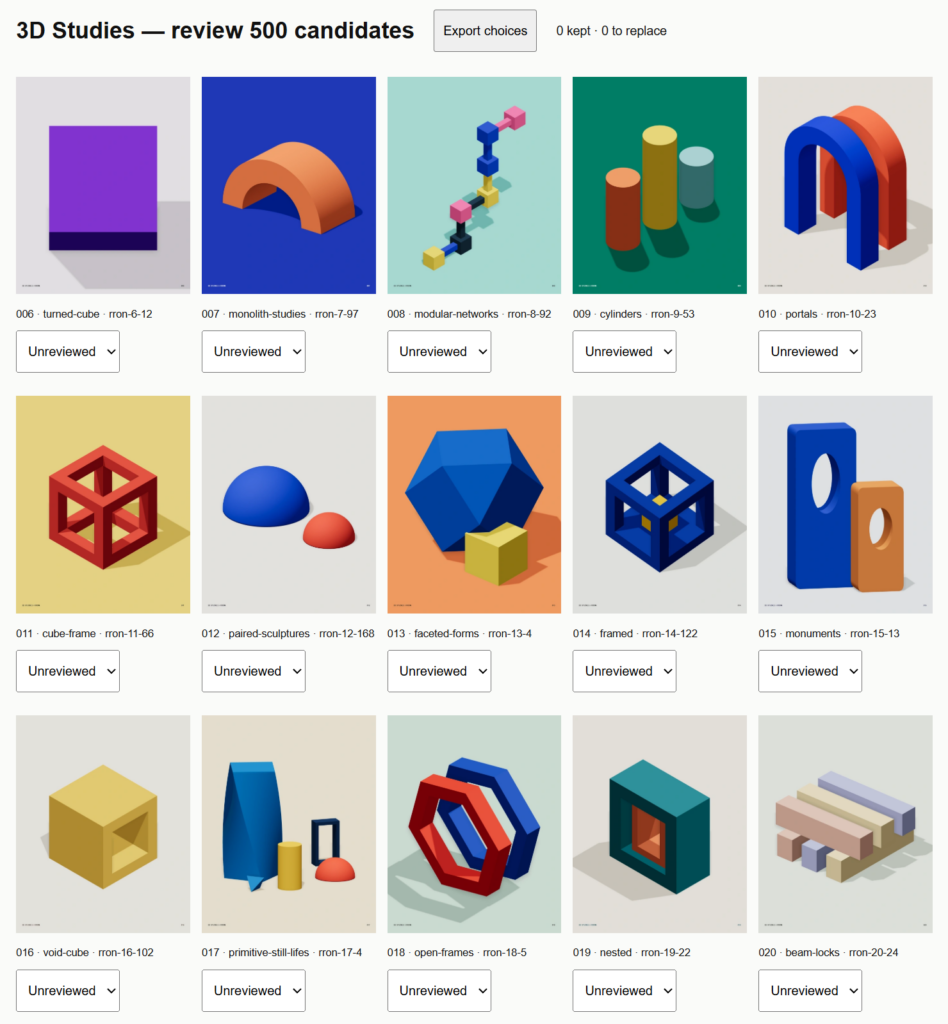
So I had Codex build me a simple review interface. It would generate 20 posters at a time, and I could go through them, check which ones I liked and leave comments on what needed fixing.
I’d export that feedback back into Codex, adjust the generator and produce another batch of 20 or 50.
I repeated this quite a few times.
Slowly, the results improved. My comments about spacing, alignment, colours and composition turned into actual rules in the code. And instead of fixing one bad poster, we could fix something that would improve hundreds of future posters.
That’s probably the part I enjoyed most. I could focus on what looked right or wrong and work with AI to figure out how to make the system behave accordingly.
Is it AI slop?
You could call it AI slop. I understand the criticism, especially when it’s so easy to generate huge amounts of content without much thought.
But I find this way of working genuinely interesting.
I didn’t manually model or arrange these 500 artworks. I also didn’t just ask an image generator to make 500 posters. I worked with Codex to build a procedural 3D generator, reviewed its output and kept adjusting the rules until I had a collection I was happy with.
I was essentially acting as a creative director for a system that I was building at the same time.
Of course, not every one of the 500 posters is great. I’ve looked through all of them, and there are definitely some I like more than others. But together, they form a coherent collection that reflects the style and decisions I put into the generator.
And that’s what I find exciting about AI and creative coding. I can work on the overall direction and the rules behind something, rather than having to make every individual part myself.
500 more?
The other nice thing is that the project doesn’t really have to end.
I could generate another 500 posters using the same system. Or I could introduce new shapes, change the colour palettes, improve the lighting or completely rethink the compositions.
I’m actually considering doing another batch to bring the collection to 1,000.
For the next series, I’d probably move away from the centered still-life compositions. Maybe something more architectural, with larger shapes, closer camera angles and objects extending beyond the frame.
I’d still use the same process: generate a batch, review it, give feedback and keep refining.
I think that’s the biggest change in how I approach making things with AI. Rather than spending my time creating one finished piece, I can work on a system that produces hundreds of variations of an idea.
I still get to make the creative decisions. I’m just making them at a different level.